






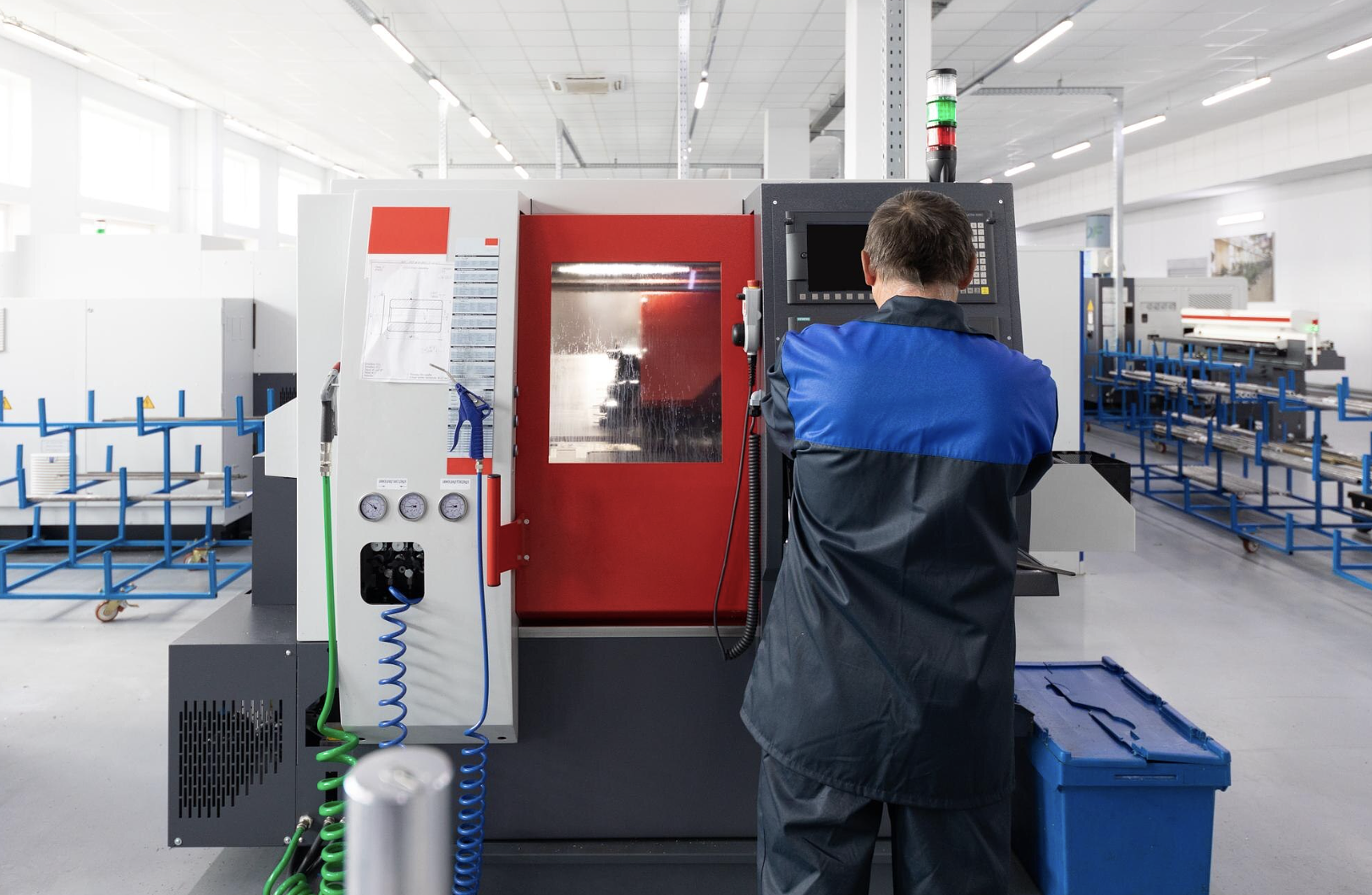
Five-axis machining centres command a real premium over three-axis machines, and that premium only makes sense for certain work. The extra two axes reduce setups, reach complex geometry, and hold tighter feature relationships; but they add cost, programming, and maintenance. This guide explains the difference and shows when a used 5-axis machine earns its price and when a 3-axis machine is the smarter buy.
What is the difference between 3-axis and 5-axis machining?
A 3-axis machining centre moves the tool in three linear directions: X, Y, and Z; so it cuts from one direction at a time. A 5-axis machine adds two rotary axes that tilt and rotate the tool or the part, letting it reach five faces of a workpiece in a single setup.
The two rotary axes are the whole difference. On a 3-axis machining centre, machining more than one face of a part means re-fixturing and re-indicating it for each side. A 5-axis machine reorients the part or the spindle under program control, so features on different faces are cut in one setup with one datum. That single-setup capability is what drives both the benefits and the cost.
What are the two types of 5-axis machining?
There are two modes: 3+2 positional and full simultaneous. In 3+2 machining, the two rotary axes tilt the part to a fixed angle, then the machine cuts in ordinary 3-axis motion. In full 5-axis, all five axes move at once to follow complex, continuous surfaces.
Most shops enter 5-axis through 3+2, because it delivers the biggest practical win i.e. machining multiple faces in one setup without the hardest programming. Full simultaneous 5-axis is for organic and sculpted surfaces such as impellers, turbine blades, and complex moulds, where the tool must stay tangent to a curving form. A used 5-axis machine may be strong at one mode and rarely used in the other, so ask how the previous owner ran it.
What are the advantages of 5-axis machining?
Five-axis machining reduces the number of setups, shortens tools, and reaches geometry a 3-axis machine cannot. Fewer setups mean less handling, less fixturing, and tighter accuracy between features, because the part is cut from one datum instead of several.
The setup reduction is usually the largest saving. A part needing five 3-axis setups may need one on a 5-axis machine, which cuts labour, reduces scrap from re-fixturing errors, and improves feature-to-feature tolerance. Tilting the head also lets a shorter tool reach deep pockets and steep walls, and a shorter tool is more rigid, so it leaves a better finish and lasts longer. For deep or angled features, that access alone can justify the machine.
When does 5-axis pay off?
Five-axis pays off on parts with features on many faces, complex or contoured surfaces, and tight feature-to-feature tolerances; especially in aerospace, medical, mould, and die work. The higher the part value and the more setups a 3-axis approach needs, the faster the machine returns its cost.
Do the maths on setups and scrap, not just cycle time. If a family of parts each needs four or five 3-axis setups, the labour, fixturing, and error those setups create often outweigh the 5-axis premium over a year of production. High-value parts where a scrapped piece is expensive make the case stronger still. For low-mix, high-value, multi-face work, 5-axis is frequently the lower total cost despite the higher machine price.
When is a 3-axis machine enough?
A 3-axis machine is enough for prismatic parts machined from one or two faces, prototyping, and general job-shop work. It costs less, programs more simply, needs less operator training, and covers the majority of milling and drilling that Canadian shops actually run.
Buying 5-axis capability you will not use is a common and expensive mistake. If your parts are flat or box-shaped and finished from the top and maybe one other face, a 3-axis machine does the job for far less money and complexity. Many shops run several 3-axis machines and add one 5-axis only when a specific contract requires it, which keeps capital efficient.
Is a used 5-axis machine harder to buy and maintain?
Yes, a used 5-axis machine needs more scrutiny. The two rotary axes; a trunnion table or a swivel head add mechanisms that wear and require calibration, and the control and CAM support are more demanding. Inspect the rotary axes, check calibration records, and confirm programming support before buying.
Budget for the added complexity. Test the rotary axes through their full range during the under-power test, and ask for any recent calibration or ballbar results, since 5-axis accuracy depends on the rotary centres being trued. Confirm your CAM software and post-processor support the specific machine, because 5-axis programming is not portable between machines the way 3-axis code often is. The reward for the extra diligence is production-grade capability at a fraction of new-machine cost.
3-axis or 5-axis: how do you decide?
Decide by counting setups and looking at part geometry. If your parts finish in one or two faces and setups are few, a 3-axis machine is the economical choice. If parts have features on many faces, contoured surfaces, or tight relationships between features, 5-axis reduces setups enough to justify its cost.
Write down a representative part family and count the 3-axis setups each part needs. Multiply by your labour rate and expected volume, then weigh that against the 5-axis premium and its programming overhead. The numbers, not the novelty of five axes, should make the decision.
Where can you buy used machining centres in Canada?
Gizmo Machine Tools sells inspected, power-tested used vertical machining centres and horizontal machining centres, including multi-axis machines, from Mississauga, Ontario, with delivery and service across Canada. A dealer that tests rotary axes and control function removes much of the risk in a used multi-axis purchase.
Match the axis count to your parts before you match it to your budget, and confirm the machine runs on Canadian power and can be supported after installation. We can also assist you to commission and service the machine on your floor.