






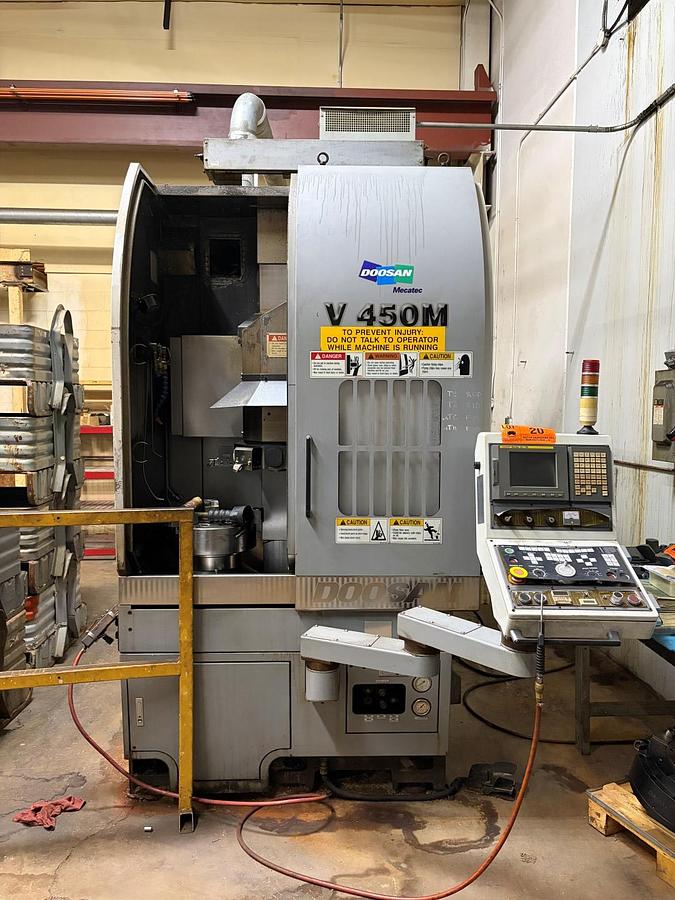
Doosan horizontal machining centres are among the most common HMCs on the used market, which makes them a practical, well-supported buy for Canadian shops moving into pallet-changer production. This guide covers the model lines you will see, the specifications that matter, the Doosan-to-DN Solutions name change, and what to check before buying one for a Canadian floor.
Why are Doosan horizontal machining centres a good used buy?
Doosan HMCs are widely deployed, so parts, service, and operator familiarity are easy to find, and their Fanuc controls are among the best-supported in the industry. Strong build quality and high resale demand make a used Doosan a lower-risk entry into twin-pallet, multi-face production than a rarer brand.
Availability is the practical advantage. Because Doosan sold HMCs in volume across North America, the used market has depth, which keeps pricing competitive and spares accessible. A shop buying its first horizontal machining centre benefits from that support base, since the machine, its Fanuc control, and its pallet system are all familiar to technicians across Canada.
What Doosan HMC model lines should you know?
Doosan horizontal machining centres fall into a few families: the older HP and HM series, the compact HC series, and the newer NHM and NHP high-productivity series. Pallet size is the quickest identifier; the model number often reflects it, with the 4000 running a 400 mm pallet and the 5000 a 500 mm pallet.
The NHP series (NHP 4000, 5000, 5500, 6300, 8000) is the current high-productivity line, built for fast rapids and heavy chip loads. The HP series (HP 4000, HP 5100, HP 6300) and the large HM series (HM 1000, 5000, 8000) are earlier and heavier, with box guideways and high spindle torque for big, rigid cuts. The compact HC 400 suits smaller parts. Knowing which family a used machine belongs to tells you its era, its control generation, and roughly what it should cost.
What is the difference between the Doosan HP and NHP series?
The HP and HM series are the earlier, heavier-built machines, often with CAT50 spindles and box guideways for maximum rigidity on large, heavy cuts. The NHP series is the newer high-productivity design with faster rapids up to 60 m/min, refined pallet indexing, and a reduced footprint for the same work envelope.
Choose between them by the work. An HP or HM machine with a CAT50 spindle and box ways excels at heavy steel, large moulds, and high-torque roughing where rigidity is the limit. An NHP machine trades some of that mass for speed and throughput, with faster acceleration and quicker pallet changes that lift parts-per-hour. On the used market the older HP and HM machines often cost less, while a used NHP brings near-current productivity below new-machine pricing.
What specifications do Doosan HMCs typically have?
A typical Doosan HMC pairs a Fanuc control (commonly a 31i-Model B on later machines) with a twin automatic pallet changer, a full B-axis rotary table indexing to 0.001°, and through-spindle coolant around 1,000 psi. Smaller models use a CAT40/BT40 spindle up to 15,000 RPM; larger models use a higher-torque CAT50/BT50 spindle.
Expect a 60-tool changer as standard, expandable on many machines, and a chip conveyor with center-through-bed chip management. The NHP 4000 and 5000 run a 15,000 RPM, 40 HP spindle with a high-torque option, while the large HM machines deliver very high spindle torque at lower RPM for heavy removal. Treat these as typical figures; always confirm the exact machine's pallet size, spindle, taper, control, and options against its own spec sheet before buying.
Is it “Doosan” or “DN Solutions”?
Both names refer to the same machines. Doosan Machine Tools was renamed DN Solutions around 2022, so machines built since then may carry DN Solutions branding while earlier machines wear the Doosan name. The mechanicals, model lines, and Fanuc controls carried over, so a used “Doosan” and a used “DN Solutions” of the same model are the same machine.
The name change matters mainly for parts and paperwork. When sourcing spares or documentation, search both names, since listings and dealers use them interchangeably. The rebrand does not affect the machine's capability or its support base; Fanuc control parts and Doosan/DN pallet and spindle components remain widely available in Canada.
What should you check on a used Doosan HMC?
Check the pallet changer and B-axis table through a full cycle, confirm spindle hours and condition, verify the Fanuc control generation and that it powers up cleanly, and test through-spindle coolant pressure. The pallet and rotary systems are what distinguish an HMC, so inspect them closely under power.
Run the automatic pallet changer through several swaps and index the B-axis across its range, listening for hesitation or alarms. Confirm the tool changer cycles all pockets. On older HP and HM machines, check the control generation carefully, since very early Fanuc systems (such as 18i) are supportable but harder to source parts for than a 31i. As with any used machine, insist on an under-power test and a documented spindle-hour count; the same discipline in a full pre-purchase inspection applies to every HMC.
Will a used Doosan run on Canadian power?
Only with the right transformer if the machine came from the US market. North American Doosan HMCs are commonly wired for 200–240 V or 480 V, while Canadian shops supply 575/600 V three-phase. A matched step-down transformer converts your 600 V supply to the machine's rated voltage so it runs correctly.
Confirm the machine's nameplate voltage, phase, and full-load amperage before buying, then size the transformer to at least 125% of the machine's load. A large HMC draws significant current, so the transformer and drives must be sized properly and your incoming service must carry the load. Building the power conversion into the purchase price keeps a cross-border Doosan honest against a domestic one.
Where can you buy a used Doosan HMC in Canada?
Gizmo Machine Tools sells inspected, power-tested used horizontal machining centres, including Doosan and DN Solutions machines, from Mississauga, Ontario, with delivery, installation, and service across Canada. Buying from a dealer that tests the pallet changer, B-axis, and control removes the risk of an unseen fault in these complex systems.
Match the model and pallet size to your parts, confirm the machine runs on Canadian power, and factor installation into the total cost. The same team that sells the machine can commission it on your floor and support the Fanuc control and pallet system afterward.